


The biggest discount may still lead to the wrong watch. A design that looks sharp online can feel out of place at work, clash with everyday clothes or spend more time in a drawer than on a wrist. Choosing affordable designer watches for men starts with how the watch will be worn, not the size of the saving.
It’s easy to focus on the dial or brand name first. But comfort, case size, strap style and useful features all affect whether a watch suits its wearer and gets regular use. Start with the setting: daily wear, a smart occasion or a more relaxed routine.
This guide offers a practical way to compare men’s designer watches by use, design and the details stated in each product description. You’ll learn how to narrow down styles, assess fit and weigh features without relying on discount claims alone. Use these criteria to make a considered choice from the watches available to browse online.
What makes an affordable designer watch for men a considered choice?
An affordable designer watch for men is a brand-led watch that fits the buyer’s budget and intended use, with a design and stated features that suit the wearer. There’s no universal price threshold for “affordable”. A sensible choice depends on what the buyer is comfortable spending and whether the watch is likely to be worn for work, everyday activities or particular occasions.
“Designer” describes the appeal and identity of a brand’s design. It doesn’t, by itself, promise luxury-watch materials, construction or movement specifications. A clean dial and branded look may be the main attraction, but practical details still need to be assessed separately. A bold, colourful design might suit casual outfits, whilst a restrained dial may feel more at home with formal clothing. Neither is automatically better. Consider the wearer’s wardrobe, preferences and routine.
Keep appearance and suitability distinct. A watch can look striking in a product image yet have a case size, strap type or dial layout that doesn’t match the wearer’s comfort or needs. Treat the description as a guide to the item, not a guarantee that it will suit every setting. Browsing a range online makes it easier to compare design choices side by side.
How to think about value beyond the discount
Start with the intended use, then compare the listed design, materials and functions against it. A simple dial may be easier to pair with work clothes, while a more detailed display could appeal to someone who prefers a stronger visual feature. These are style considerations, not promises of performance.
A markdown alone can’t establish suitability, quality or long-term satisfaction. Compare like with like: look at watches intended for similar settings, then assess their product information and design details on the same basis. This stops a sale label from outweighing the factors that will matter after purchase.
Which details in a listing deserve attention?
Read the specifications separately from the promotional copy. Check the case material, dial features, strap type and movement when these are stated. Styling terms describe appearance; specifications provide more concrete points for comparison. For background on how watch types and mechanisms differ, see History and types of watches.
Case material distinguishes one stated construction from another; dial details describe the display and layout; strap type tells you what fastens the watch; and movement identifies whether it is described as quartz or mechanical. Compare these details across listings without assuming a feature that isn’t specified.
How to compare men’s designer watches by design and listed features
Compare the look first, then check whether the listed details suit the intended use. The table offers a starting point. These are broad style categories, not guarantees about what a particular watch can do.
| Design | Visual impression | Likely occasions | Listing details to compare |
|---|---|---|---|
| Dress-led | Often restrained, with a cleaner dial and a refined case appearance | Work, formal events or smart outfits | Dial layout, case material and whether the strap is leather or another material |
| Everyday | Balanced styling intended to pair with a range of clothing | Regular wear across casual and smart-casual settings | Case size, dial legibility, strap type and stated movement |
| Sport-inspired | May have a more prominent case, bold markers or extra dial features | Casual outfits and occasions where a stronger look feels appropriate | Chronograph functions, glass type and any stated water-resistance rating |
Everyday, formal and sport-inspired looks
Dial layout, case shape and strap style each affect the overall impression. A simple dial with a leather strap can look more formal; a metal bracelet or high-contrast markers may create a casual, contemporary feel. These are visual cues, not fixed rules. Clean, understated designs can be versatile if you want one watch to work with several outfits, but personal taste and wardrobe still matter.
Sport-inspired styling doesn’t prove that a watch is suitable for swimming or demanding activities. Look for a stated water-resistance rating and read what the listing says it means. If you intend to wear a watch around water, don’t infer its suitability from a sporty case or bold dial alone.
Movement, case and strap details to compare
Quartz watches use an electronic movement regulated by a quartz crystal; automatic watches use a mechanical movement that winds as the wearer moves. These terms describe different mechanisms, not a simple quality ranking. Consider which type appeals to the wearer, then compare the listed details. For wider context on the craft, the Watchmaking standards and craftsmanship resources from the American Watchmakers-Clockmakers Institute introduce professional watchmaking and horology.
Check materials only as stated. A listing might specify a stainless-steel case or a leather strap, but don’t assume either from a photograph. Glass type, chronograph features and water resistance also need explicit specification. A chronograph adds timing functions to the display; its presence alone doesn’t indicate how the watch performs in other settings.
Use these points to compare affordable designer watches for men on equal terms: note the design, intended occasion, movement, materials and any named functions for each option. Put the framework into practice by browsing men’s designer watches and comparing the styles and details shown in their listings.
Which affordable designer watch suits his routine, wardrobe and wrist?
Start with the wearer’s real habits, not an imagined ideal. A watch for regular use needs to work with the clothes he actually wears and feel comfortable through an ordinary day. A watch for a particular event can be chosen for that setting instead. Use this checklist to narrow the options:
- Routine: Is the watch intended for frequent wear or a specific occasion?
- Clothing: Does he usually wear casual, smart-casual or formal outfits?
- Visual detail: Does he prefer a clear, understated dial or a more noticeable design?
- Wrist and strap: What case proportions and strap styles does he already find comfortable?
These points turn browsing into a more personal comparison. They keep the choice focused on how a watch will look and feel on its intended wearer, rather than assumptions about who should wear a particular style.
Choose a watch for regular wear or a specific occasion
For frequent wear, look for a design that works with the wearer’s usual wardrobe. A simple dial and restrained case can pair with different outfits; a more distinctive design may suit someone who enjoys a clear focal point. For formal occasions, understated details can complement smart clothing, but a watch isn’t required to complete an outfit.
If the watch needs to suit varied settings, weigh versatile styling against a more individual look. Neither is automatically the stronger choice. The useful question is which design he’ll feel comfortable wearing across the occasions that matter to him.
Use fit and personal taste to narrow the shortlist
Case proportions affect a watch’s visual scale on the wrist. Check the stated case dimensions and compare them with a watch he already finds comfortable. A larger-looking case may draw more attention, whilst a more compact design can feel visually discreet. These impressions depend on the wearer’s wrist and preferences, so dimensions are a guide rather than a universal fit rule.
Separate comfort from appearance. Dial readability, strap preference and overall visual scale are different considerations: a bold dial may appeal visually, while the strap affects how the watch sits against the wrist and works with clothing. Consider each in turn. A considered shortlist of affordable designer watches for men matches personal preferences to stated dimensions and design, rather than relying on a general rule about wrist size.
For a gift, use what you know. Notice the colours he wears, whether he favours metal or leather accessories, and whether his existing watches are simple or detailed. These are useful style cues, not fixed rules. If his preferences are unclear, choose a design that reflects what he already wears rather than making assumptions based on age, job or personality. The aim is a watch that feels suited to him.
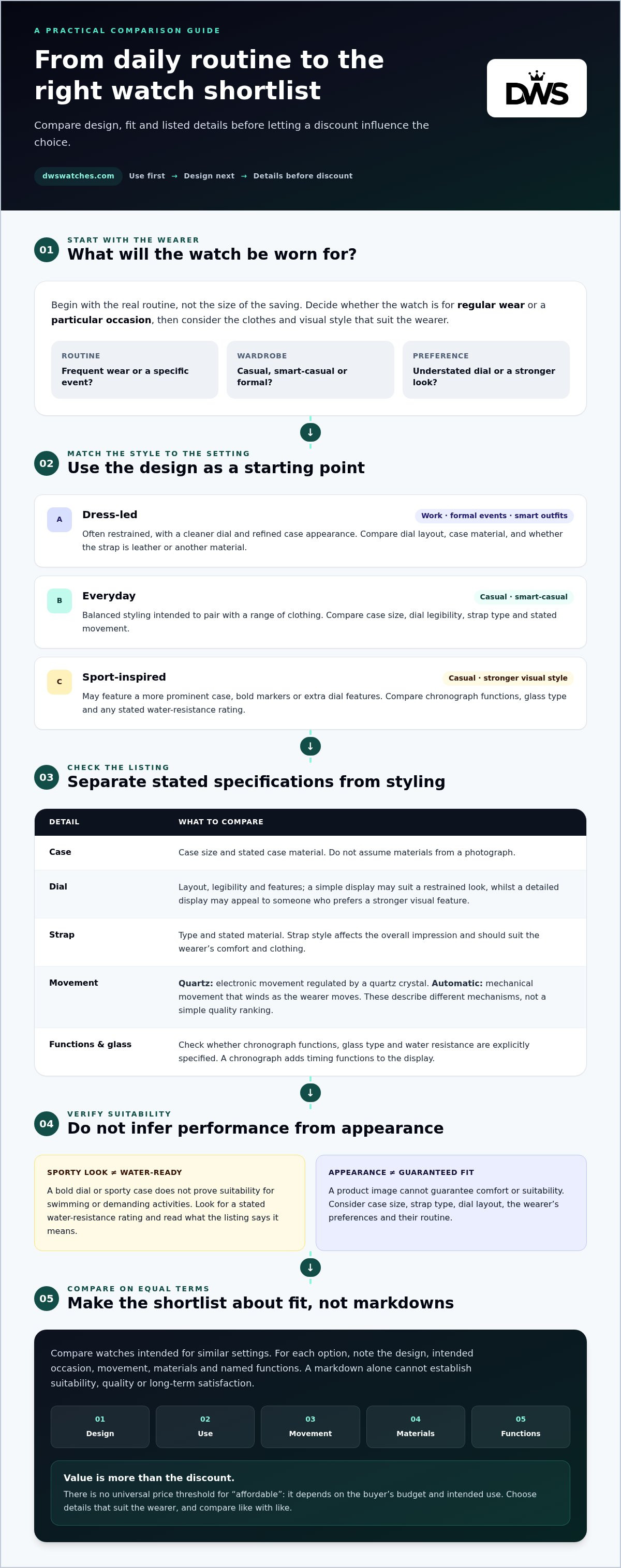
A practical shortlist: five checks before choosing an affordable men’s designer watch
A clear shortlist makes the decision easier. Begin with the person who’ll wear the watch and the settings it needs to suit. Then compare the same details across a small group of options. This gives each watch a fair assessment and stops a discount from becoming the only reason to choose it.
Build a shortlist around the wearer first
Use these five checks in order. Remove an option when it conflicts with a firm preference, rather than trying to justify it because it looks appealing at first glance.
- Check 1: Purpose. Decide whether the watch is for regular wear, a particular occasion or a mix of settings. This sets the context for the comparisons that follow.
- Check 2: Preferred style. Note the dial appearance, case shape and strap style the wearer likes. A restrained design and a more distinctive one may suit different wardrobes and tastes.
- Check 3: Fit. Compare the stated case dimensions with a watch the wearer already finds comfortable. Set aside options whose proportions don’t match their preference.
- Check 4: Stated specifications. Review the movement, materials, dial features and any functions described in the listing. Treat promotional wording as description, not proof of an unstated feature.
- Check 5: Listing comparison. Read each shortlisted product description using the same criteria. Review the stated product and order information, and separate listing facts from assumptions based on photographs or styling.
This order keeps the wearer at the centre of the decision. Start broad, with purpose and visual preference; then use fit and product details to narrow the options. If a stated dimension or feature doesn’t suit the wearer, remove that watch rather than keeping it on the shortlist simply because of its appearance.
Compare listings before making the final choice
Make a simple comparison using the same headings for each option: design, case dimensions, strap, movement, named functions and any other relevant stated specification. Fill in only what the listing says. If a detail isn’t stated, mark it as unspecified in your notes rather than guessing from an image. This is especially useful when several watches share a similar overall look.
Next, revisit the intended use. A watch for regular wear should align with the wearer’s usual clothing and preferences; one for an occasion can be judged against that setting. Check that the product description and order information fit your selection, then make the decision based on the full picture rather than a single highlighted claim.
A clear shortlist beats discount-led browsing because it gives each option the same practical test. For more selection context, read the men’s affordable designer watches buying guide. Apply these checks to current options by browsing men’s designer watches and comparing the details provided for each listing.
Find an affordable designer watch for men that fits your shortlist
A considered choice follows a clear order: start with the wearer’s routine and preferred style, then compare fit and the specifications stated in each product description. This keeps the decision grounded in the watch’s intended use. There’s no single material, movement or design that suits every buyer, so let the wearer’s priorities guide the final comparison.
Make the final choice with clear priorities
Before comparing the last few options, name the two criteria that matter most. They might be comfortable proportions and a simple dial, or a distinctive design and a preferred strap. Use those priorities to weigh each option. A less important feature can still be a bonus, but it shouldn’t outweigh a clear mismatch with the wearer’s needs.
The right watch depends on who will wear it and where they plan to wear it. A watch for regular use may need to work with familiar clothing, whilst one for a single occasion can reflect that setting. Both are valid aims. The goal is not to find a universal winner, but to select an option that feels appropriate for this wearer.
- Purpose: Match the watch to regular wear or a particular occasion.
- Style: Compare the dial, case appearance and strap with the wearer’s preferences.
- Fit: Use stated dimensions as a guide to the proportions they prefer.
- Specifications: Base comparisons on details the listing actually gives.
- Value: Consider the match with intended use, not a discount in isolation.
Browse with a value-focused perspective
Use your shortlist to browse the store’s online selection of affordable designer watches for men. Compare product descriptions on the same points, and keep unstated details separate from information provided in the listing. For wider context on how designer watches are presented in the UK, explore this guide to designer watches for sale in the UK.
Brand preference can also help organise the final comparison, provided it supports rather than replaces checks on fit, design and listed features. The best-value designer watch brands in the UK offers broader brand-level context to consider alongside an individual watch’s details.
Take a final moment to confirm that your two priorities still lead to the same choice. A well-matched shortlist makes it easier to select with purpose, without treating one style or specification as automatically best for every buyer. Browse affordable designer watches for men.
Make your next choice with confidence
Set your priorities before you browse: decide what matters most to the wearer, then use those preferences to guide the final choice. A watch should feel like a natural fit for the person and the moments they’ll wear it. There’s no need to choose the most striking option or the one with the biggest markdown if another design better suits their everyday style.
Explore designer watches from popular fashion brands through an online store focused on accessible pricing for UK shoppers. Compare the options at your own pace and let the wearer’s preferences lead. The right affordable designer watches for men are the ones that feel considered for their intended use, not simply tempting at a glance.
Browse affordable designer watches for men and take the next step towards a choice that feels right for its wearer.
Frequently Asked Questions
Are affordable designer watches worth buying?
They can be, if the design, stated features and intended use justify the choice for you. The label alone doesn’t establish build quality or guarantee long-term satisfaction. Compare the product details with what you need from a watch, then consider whether it’s a design you’ll enjoy wearing. Affordable designer watches for men are best judged by personal fit, not branding or a reduced price alone.
Can an affordable designer watch make a good gift for a man?
Yes, if the choice reflects his preferences rather than assumptions about his age or job. Notice the watches and accessories he already wears: does he favour a simple face, a prominent dial, a metal bracelet or a particular strap style? If you’re unsure, choose a design that sits comfortably alongside his usual clothing. A gift feels more considered when it matches his existing taste, even if it isn’t the most eye-catching option.
Do designer watches hold their value?
Don’t assume a designer watch will retain its purchase value or become an investment. Future resale interest can vary with the brand, specific watch, condition and demand at the time. A discount or recognisable label doesn’t guarantee a particular resale outcome. If resale matters to you, treat it as uncertain and choose a watch you’d be happy to own and wear, rather than relying on a future sale to make the purchase worthwhile.
Can I wear a designer watch every day?
Yes, if its fit, style and stated specifications suit your regular routine. Think about the environments you encounter, such as commuting, desk work or outdoor activities, and check relevant listing details rather than assuming a watch can handle every condition. In particular, don’t infer water suitability from a sporty appearance. Comfort matters too: a watch that feels intrusive or doesn’t suit your daily clothing may see less wear.
How can I tell whether a watch is the right size for my wrist?
Use the listed case dimensions as a guide, then compare them with a watch you already find comfortable. Case diameter is useful, but it isn’t the whole picture: case thickness and the distance from one side of the case to the other can also affect how the watch looks on your wrist, if stated. Consider the strap separately. The best proportions depend on your wrist and personal preference, not a universal size rule.
What should I check in an online watch listing before buying?
Check whether the description gives the details you need to compare the watch: movement, case material, dimensions, strap type, dial functions, and glass or water-resistance specifications where stated. Don’t treat styling language or a photograph as proof of a feature. Review what the listing says is included, then read the product and order information before proceeding. If a detail matters to your decision but isn’t specified, don’t guess.