


What if the prestigious designer logo on a watch dial is masking fragile base metals and a disposable movement? You expect an investment in personal style to deliver durable craftsmanship, yet vague high-street descriptions often obscure how a timepiece is genuinely built. Deciphering technical specifications like 316L stainless steel, mineral glass, sapphire coating, and quartz calibres shouldn't feel like an industry puzzle. This designer watch build quality guide cuts through the retail branding hype, establishing measurable engineering standards so you can verify physical craftsmanship before purchasing.
We'll provide the exact benchmarks required to assess case metallurgy, crystal scratch resistance, solid strap hardware, and internal movement performance. You'll discover how to inspect structural finishing, recognise robust components at accessible price points across the UK, and filter out fragile fashion novelties with absolute certainty. Here is the straightforward criteria you need to secure lasting value and enduring design for your wrist.
Defining Designer Watch Build Quality: Case Materials and Structural Integrity
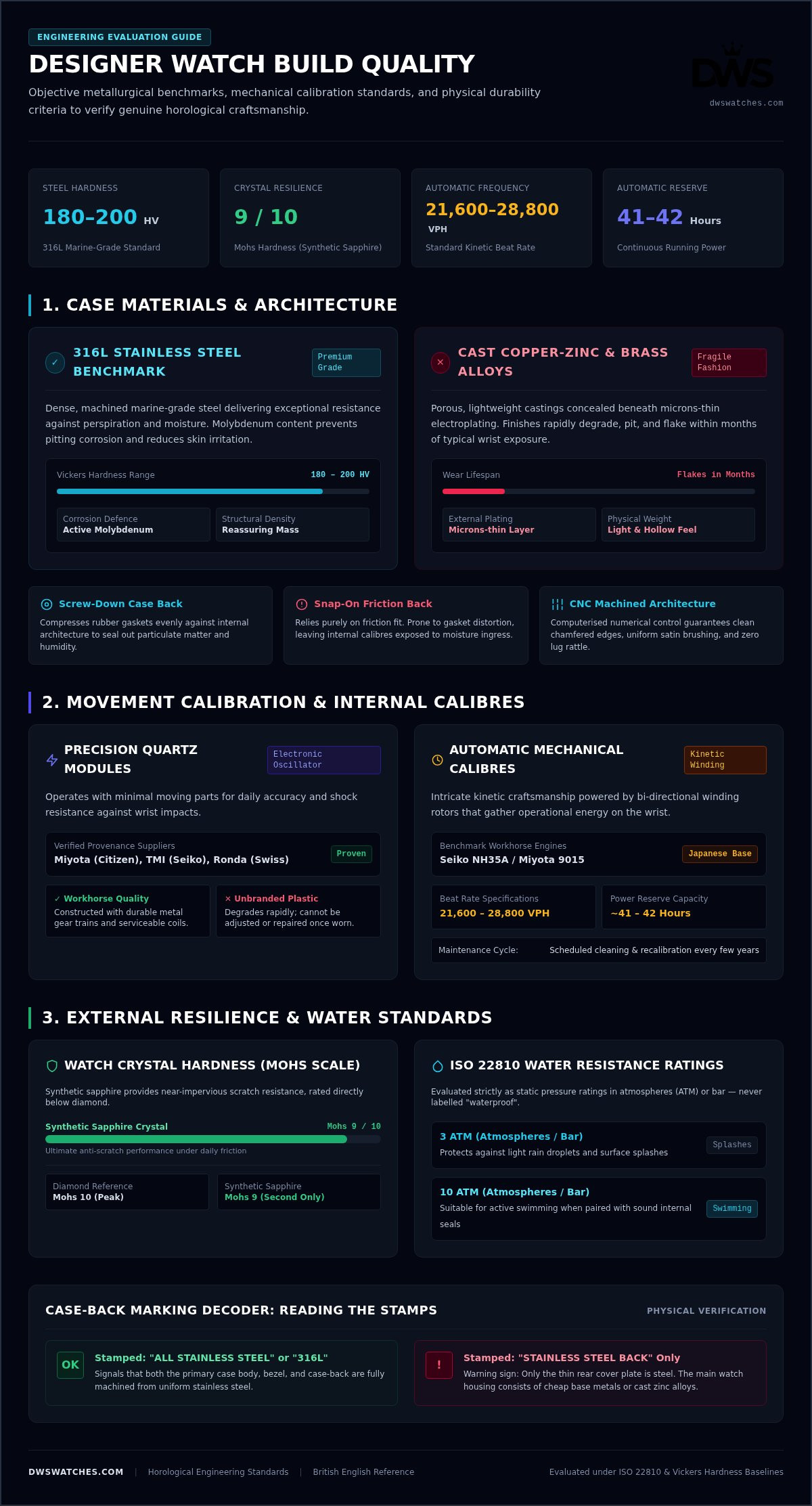
Build quality begins with raw metallurgy and tight assembly tolerances. A durable timepiece feels dense, balanced, and solid in the hand. Weight often reveals structural integrity; cheap zinc alloy castings feel hollow and light, while solid machined steel provides reassuring mass. Case-back construction also signals longevity. Screw-down case backs compress internal rubber gaskets evenly against the case architecture, sealing out particulate matter and humidity. Basic snap-on backs rely on friction fit alone, leaving the internal movement vulnerable to everyday environmental exposure. This designer watch build quality guide establishes clear material baselines to help you evaluate the housing before making an investment.
Stainless Steel Grades: Why 316L Remains the Industry Benchmark
Marine-grade 316L stainless steel delivers superior corrosion resistance against sweat and moisture, supported by a standard Vickers hardness of roughly 180 to 200 HV. Its molybdenum content prevents pitting and reduces skin irritation. Conversely, inferior fashion timepieces often cast cases from copper-zinc alloys or brass, concealing base metals beneath a fragile microns-thin electroplate that degrades and flakes within months. Always inspect the case markings. A stamp reading "Stainless Steel Back" reveals that the main housing is actually cheap base metal; insist on "All Stainless Steel" or explicit 316L construction.
Machining, Tolerances, and Case Architecture
Precision computerised numerical control (CNC) machining defines high-grade assembly. Every seam must fit with microscopic tolerances. Seamless transitions between the case, bezel, and lugs eliminate internal movement rattle whilst protecting internal gaskets from moisture ingress. When evaluating case architecture, look for clean chamfered edges and uniform satin brushing. Poor manufacturing betrays itself immediately through sharp, unchamfered edges that catch on clothing, misaligned bezels, and uneven gaps where the bracelet meets the case profile. Consistent finishing reflects genuine manufacturing control.
Movements and Calibration: The Engine Inside Your Designer Timepiece
Movement selection dictates the operational lifespan of any watch. While luxury marketing often elevates mechanical calibres as the sole mark of horological pedigree, practical daily wear demands realistic mechanical assessment. Reputable designer brands partner with proven movement manufacturers rather than relying on anonymous assemblies. Provenance matters. Knowing whether your watch runs on a reliable Japanese or Swiss base reveals genuine manufacturing value. For a comparative breakdown of movement sourcing across leading fashion houses, explore our curated review of the best value designer watch brands uk. Applying this designer watch build quality guide ensures you invest in lasting mechanical integrity.
The Role of Precision Quartz in Modern Designer Horology
Battery-powered quartz calibres provide exceptional shock resistance and daily timekeeping accuracy. Operating with minimal moving parts, an electronic oscillator withstands impacts that would knock an intricate mechanical escapement out of alignment. Established suppliers like Miyota (Citizen Group), TMI (Seiko), and Swiss Ronda engineer workhorse quartz modules featuring metal gear trains and serviceable coils. Conversely, unbranded plastic movements found in unverified fashion watches fail prematurely, resisting repair or adjustment once internal components degrade.
Automatic Movements in Accessible Designer Watches
Mechanical movements introduce complex kinetic craftsmanship into modern collections. Solid automatic options typically feature Japanese calibres such as the Seiko NH35A or Miyota 9015. These workhorse movements deliver 21,600 to 28,800 vibrations per hour, offering approximately 41 to 42 hours of reserve power. Smooth, bi-directional winding rotors ensure efficient energy transfer on the wrist. Keep in mind that mechanical calibres require scheduled cleaning and recalibration every few years to retain accuracy, unlike the grab-and-go reliability of high-grade quartz modules.
Discerning buyers can evaluate these engineering standards across our online catalogue at dwswatches.com, where transparent specifications guide every selection.
Dial Detailing, Crystal Selection, and External Resilience
The external face of a watch endures constant contact, friction, and environmental exposure. Visual appeal doesn't matter if daily wear leads to cloudy crystals, rubbed-off finishes, or moisture damage. Water resistance ratings demand precise interpretation under standard ISO 22810 guidelines. Honest manufacturers don't claim a watch is "waterproof"; they specify static water resistance in atmospheres (ATM) or bar. A 3 ATM rating protects against rain and light splashes, whereas swimming requires at least 10 ATM paired with sound internal seals. This designer watch build quality guide clarifies what protects the dial before you commit.
Watch Crystal Hierarchy: Hardness and Scratch Resistance
Synthetic sapphire crystal rates at 9 on the Mohs hardness scale, second only to diamond. It resists scratching from keys, concrete, and steel. Hardened mineral glass registers between 5 and 6 on the Mohs scale; it absorbs impacts well, but gathers hairline scratches over time. Sapphire-coated mineral offers an intermediate solution, yet solid sapphire remains the ultimate shield. Always verify internal anti-reflective coatings. External coatings scratch easily, marring the crystal even when the glass underneath remains pristine.
PVD Coatings, Ion Plating, and Colour Longevity
Physical Vapour Deposition (PVD) vaporises metal within a vacuum chamber, bonding colour directly to the underlying stainless steel. This process ensures gold, rose gold, and matte black finishes resist abrasion and sweat. Cheap electroplating, by contrast, deposits a fragile surface wash that quickly wears away at the case edges and bracelet links. Preserve plated surfaces by wiping away perspiration, cologne, and body oils with a dry microfibre cloth after wear.
Dial Application and Hands Alignment
Dials reveal a brand's manufacturing standards under scrutiny. Look for sharp, raised indices secured without visible adhesive residue. Typography must remain crisp under close inspection, free from ink bleed or fuzzy margins. On quartz models, check that the second hand strikes each minute marker dead-centre rather than hovering loosely between chapter ring lines. Evenly applied luminous paint provides consistent daylight colour and uniform illumination across hands and indices in the dark.
The 5-Point Build Quality Checklist for Evaluating Designer Watches
Independent evaluation requires an objective audit rather than reliance on brand marketing. Use this designer watch build quality guide to scrutinise five vital benchmarks before purchasing any fashion or designer timepiece:
- 1. Case Composition: Verify solid 316L stainless steel rather than generic metal alloys.
- 2. Crystal Specification: Confirm sapphire or hardened mineral glass over untreated acrylic.
- 3. Calibre Heritage: Ensure a named Japanese or Swiss movement powers the dial.
- 4. Hardware Tolerances: Check for solid bracelet links, secure end links, and rigid clasp plates.
- 5. Crown and Seal Security: Test crown stability and verify clear ATM depth ratings.
Step-by-Step Hands-On Inspection Protocol
Isolate tactile feedback during physical assessment. Solid stainless steel bracelet links have smooth, unified side profiles. Cheap alternatives use folded sheet metal, visible as hollow seam lines along the link edges that pinch skin and stretch over time. Solid end links should sit flush against the watch case without lateral play or rattling. Test the deployment clasp; it should engage with a crisp, reassuring click rather than flexing under pressure. Finally, audit the crown. Pull it out through date and time setting positions. It shouldn't wobble on its stem, and hand adjustment should offer smooth, even resistance.
Reviewing Digital Specifications Before Purchase
Digital shopping demands rigorous specification filtering. Ambiguous product descriptions signal compromised production. Terms such as "metal case", "water resistant" without numerical depth ratings, or "Japanese movement" lacking an exact calibre designation often conceal disposable components. Reputable retailers state exact metal grades, movement suppliers, and crystal types directly on product pages. Cross-reference curated options using our guide to designer watches for sale uk to identify brands meeting these standards. To secure a verified timepiece backed by transparent specifications, browse our curated designer watch collection.
Curated Horology: Securing Premium Build Quality at Accessible Price Points
Securing genuine build quality shouldn't require luxury retail markups. High-street jewelers and physical showrooms carry immense real estate overheads, staffing costs, and distributor margins. These expenses inflate retail tags without enhancing the underlying metallurgy or movement. A direct digital model eliminates physical showroom premiums entirely, directing investment into physical craftsmanship instead. Digital curation acts as a selective filter, isolating timepieces that deliver genuine mechanical integrity. To discover pieces that mirror high-tier aesthetic standards without inflated brand premiums, explore our curation of expensive watch alternatives uk. By applying this designer watch build quality guide, UK collectors can acquire dependable horology with total financial discipline.
The Value Equation: Style Alignment Versus Horological Longevity
Modern horology balances sharp runway aesthetics with durable construction. You don't have to settle for fragile fashion novelties to wear a stylish profile. Look past front-facing brand prestige. Focus on verified material specifications, ensuring solid steel builds and reliable internal calibres anchor the design. This deliberate balance yields versatile timepieces ready for everyday rotation, transitioning effortlessly between professional and casual British wardrobes.
Selecting Your Curated Timepiece Online
Digital shopping offers complete transparency when backed by rigorous specifications. Reliable online retailers disclose case dimensions, alloy compositions, glass types, and calibrated movements upfront. Pair clear technical disclosures with straightforward UK return policies to assess tactile quality directly on your wrist. For specific model recommendations meeting these criteria, read our complete guide to affordable designer watches UK. Make informed acquisitions, eliminate poorly built fashion novelties, and invest in watches engineered for lasting style.
Upgrade Your Wristwear with Verified Build Standards
Authentic personal style demands physical substance rather than hollow retail markups. By applying the standards established in this designer watch build quality guide, you can systematically identify solid 316L stainless steel casework, resilient crystals, and reliable Japanese or Swiss calibres before purchasing. Demanding transparent manufacturing data protects your investment, ensuring your chosen timepiece delivers dependable everyday performance alongside refined aesthetics.
Smart curation bridges the gap between runway ambition and engineering discipline. Designer Watch Store UK operates as a dedicated digital gatekeeper, eliminating physical showroom costs to offer authentic timepieces from established designer houses with complete pricing efficiency. Benefit from UK-wide national delivery, transparent product specifications, and direct digital support focused entirely on verified solid materials and dependable movements. Choose lasting craftsmanship today and Explore Curated Designer Watches designed to stand the test of time.
Frequently Asked Questions
What is the most important indicator of build quality in a designer watch?
Material composition and machining tolerances across the case and bracelet form the primary indicator. Solid 316L stainless steel paired with a screw-down case back indicates structural integrity. As highlighted throughout this designer watch build quality guide, reputable components, such as named calibres and clean dial printing, separate genuine craftsmanship from superficial branding. Inspecting whether components fit flush without rattling gives you instant proof of manufacturing quality.
Is a quartz designer watch inferior in construction to an automatic watch?
No, a well-engineered quartz timepiece isn't inherently inferior in construction. High-grade quartz modules from manufacturers like Miyota or Ronda feature robust metal gear trains and withstand physical shocks far better than complex mechanical balance springs. While automatic watches hold traditional mechanical appeal, precision quartz offers superior daily accuracy, thinner case profiles, and minimal maintenance demands for active wear. Build quality depends on component execution, not just the propulsion method.
How can I tell if a designer watch case is solid stainless steel or plated alloy?
Check the case-back markings and inspect the edges around the lugs. Solid timepieces are clearly stamped "All Stainless Steel" or specify "316L Steel". A marking that reads "Stainless Steel Back" reveals that the main case body is cast from cheap zinc or brass alloy. In addition, look closely at high-friction contact points; plated base metals often reveal discoloured, yellowish undertones where thin surface coatings wear away.
What water resistance rating is necessary for everyday designer watch durability?
A minimum rating of 5 ATM (50 metres) is recommended for dependable everyday durability. A 3 ATM rating resists accidental rain splashes, but offers limited protection during handwashing or sudden downpours. Selecting a watch rated to 5 ATM or 10 ATM ensures robust internal rubber gaskets and tighter case tolerances. This seals the dial and internal movement against UK humidity, persistent rain, and airborne moisture over years of daily rotation.
Do designer watches use real sapphire glass or mineral crystal?
Designer watches use both materials depending on price tier and design specifications. Entry-level models typically feature hardened mineral glass, offering decent shatter resistance for daily routines. Higher-tier designer pieces incorporate synthetic sapphire crystal, which scores 9 on the Mohs hardness scale for near-complete scratch immunity. This designer watch build quality guide recommends reviewing digital specifications carefully to confirm whether the watch features pure sapphire, sapphire-coated mineral, or standard mineral glass.
Why do some designer watches feel significantly heavier than others?
Weight discrepancies stem directly from the density of internal and external materials. Solid 316L stainless steel cases, solid bracelet links, and machined deployment clasps create a reassuring, substantial heft on the wrist. Cheaper fashion timepieces use hollow folded metal links, lightweight zinc alloy cases, and plastic movement-holder rings. These cost-cutting methods reduce overall mass significantly, resulting in a hollow, insubstantial feel that rattles during natural wrist movement.
Can a well-made designer watch last for decades with basic care?
Yes, a designer watch constructed from solid materials can easily endure for decades. Longevity requires a corrosion-resistant 316L steel housing, a proven Japanese or Swiss calibre, and periodic maintenance. For quartz movements, prompt battery replacements prevent chemical leakage, whilst wiping the case clean of sweat and oils preserves structural gaskets and external coatings. Investing in proper build specifications ensures your timepiece remains an enduring staple within your wardrobe.