


Professional polish comes from proportion and restraint, not a high price. The best professional watches on a budget suit your wardrobe and routine rather than making the loudest impression. A considered dial, comfortable case size and well-matched strap can make a watch feel right for work without stretching your spending limit.
It’s easy to feel uncertain when styles range from minimalist dress watches to sportier designs, and online listings place movements, materials and features side by side. A lower price alone doesn’t mean a watch will look too casual, but small details can change its overall effect. Focus on what you’ll wear, how the watch sits on your wrist and which features matter to you.
This guide will help you set a sensible budget, match a watch to professional clothing and compare key details with more confidence. We’ll cover case size, dial and strap choices, quartz and automatic movements, plus the materials and listing information worth understanding. You’ll also find practical criteria for browsing affordable designer watches in the UK and narrowing down your options.
Professional Watches on a Budget: What Makes a Watch Work at Work?
A watch looks professional when its proportions, design and level of formality suit the setting. A high price or famous label alone won’t determine how it looks with your clothes. Focus on fit, clarity and restraint.
What does professional style mean in a watch?
Neat proportions and an uncluttered dial can support a composed outfit. A watch that sits comfortably beneath a shirt cuff may suit a formal office, whilst a more robust case or coloured dial could feel at home in a creative studio or relaxed workplace. There isn’t one correct style for every UK workplace. Follow your dress code, then choose a design that feels consistent with it.
Balance personal taste with practical needs. A distinctive colour or textured dial can add character, while clear markers and hands make the time easier to read during a busy day. Comfort matters too: consider whether the case feels balanced on your wrist and whether the strap suits hours of wear. For background on types of watch movements, including the difference between quartz and mechanical designs, a general overview can help you understand terms used in product descriptions.
Set a budget around use, not status
Start with your routine. Will you wear the watch every weekday, or only for meetings and formal occasions? Which outfits should it work with: a suit, smart-casual clothing, or a mix? A versatile dial and strap may suit frequent wear, while a more expressive design could make sense if you already own a simple everyday option.
Next, decide which features have a practical purpose. Legibility, a comfortable fit and a design that works with your wardrobe may matter more than extra functions you’re unlikely to use. Don’t pay for a feature solely because it makes a listing sound impressive. Compare details that affect daily wear, and treat the brand name as one factor rather than proof of professional suitability.
A lower-priced watch may have a busy dial, oversized case or shiny finish, but none of these details automatically signals poor quality. Consider the whole design. Does the case look proportionate on your wrist? Is the dial easy to scan? Does the strap or bracelet sit neatly with your usual clothing? These checks help you assess a watch on its own merits instead of assuming that a higher price guarantees a better workplace fit.
For a clearer starting point, use an affordable designer watches UK buying guide to organise your budget and priorities. Designer Watch Store UK offers a wide selection of affordable designer watches from popular fashion brands to browse online across the UK. Keep your shortlist focused on the styles and features that suit your working life.
Choose a Professional Watch by Getting the Proportions and Details Right
A watch’s overall balance matters more than any single design feature. The case, dial and strap should feel in proportion to your wrist and work alongside your clothes, rather than competing with them. A balanced watch can feel deliberate in a meeting, at a desk or on a commute.
Case size, dial and legibility
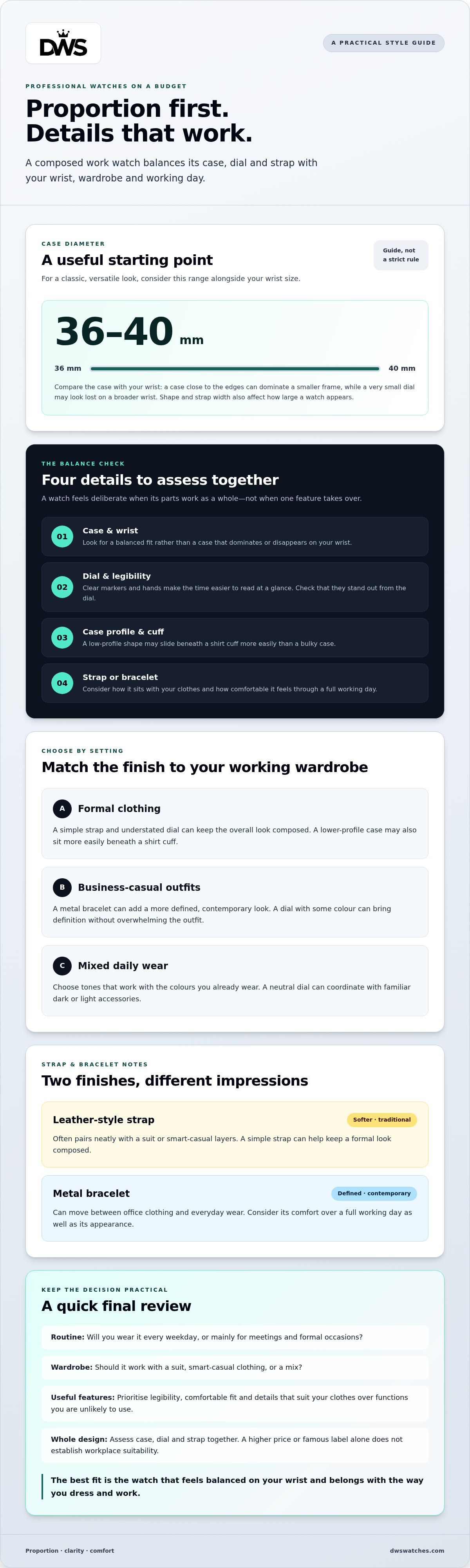
Compare the case diameter with the width of your wrist. A case that extends close to the edges of your wrist can dominate a smaller frame, whilst a very small dial may appear lost on a broader wrist. Case sizes between 36mm and 40mm are a useful starting point for a classic, versatile look, but treat this as a guide, not a rule. Case shape and strap width also affect how large a watch appears.
Consider how it sits beneath a shirt cuff. A low-profile shape may slide under more easily than a bulky one, which can matter with formal shirts and tailored jackets. Check the dial at a glance, too. Clear markers and hands help you read the time during a busy working day, particularly when you’re moving between tasks. Restrained details are one route to versatility, not a dress code: a coloured dial or subtle texture can still suit your workplace if the overall design feels balanced.
A versatile work watch balances a proportionate case, a legible dial and a strap or bracelet that sits naturally with your wardrobe.
Choose details with intent. A clean dial can create a quieter impression with formal clothing; additional markings or contrasting elements may suit a more relaxed office or a personal style that welcomes visual interest. Check that the hands and markers remain easy to distinguish from the dial. A polished appearance doesn’t require every surface to be plain.
Strap, bracelet and colour choices
A leather-style strap often gives an outfit a softer, more traditional finish and can pair neatly with a suit or smart-casual layers. A metal bracelet tends to create a more defined, contemporary look that can move between office clothing and everyday wear. Comfort is personal: consider how each option feels through a full working day, as well as how its appearance fits your usual dress code.
- For formal clothing: A simple strap and understated dial can keep the overall look composed.
- For business-casual outfits: A bracelet or a dial with some colour can add definition without overwhelming the outfit.
- For mixed daily wear: Choose tones that work with the colours you already wear, such as a neutral dial with familiar dark or light accessories.
Match the watch to your wardrobe, not just to one outfit. If your work clothes are mostly navy, grey or black, a restrained dial colour may coordinate easily. If your clothing includes warmer or brighter tones, a complementary dial can add character. Browse affordable designer watches with these visual priorities in mind, then consider how each option would sit with the clothes you wear most.
Compare Budget Watch Styles for Different Professional Settings
A professional look doesn’t require a luxury price or a complicated design. The useful question is whether a watch’s style works with your workplace and the clothes you wear there. A pared-back design can suit a formal office, whilst a more feature-rich watch may feel at home in a business-casual setting. Treat the guide below as a starting point, not a rulebook. Workplace expectations vary between sectors and even between teams.
Match the watch style to the dress code
| Style | Often suits | Consider |
|---|---|---|
| Dress | Formal offices, suits and smart meetings | A simple dial and restrained details keep the look composed. |
| Minimalist | Business-casual clothing and mixed work wardrobes | A clean face can move easily between formal and relaxed outfits. |
| Chronograph | Creative or less formal workplaces | Additional dial features add visual activity and may stand out with a suit. |
| Digital | Casual offices and practical everyday wear | The display can give a modern, functional impression; consider how that fits your dress code. |
Use the table to narrow your options, then judge the whole design. A bold dial, bright colour or oversized detail can shift an outfit’s impression from understated to expressive. That may be welcome in a creative studio or relaxed workplace, but feel less aligned with traditional business dress. Equally, a simple design isn’t automatically the right choice if it doesn’t reflect your taste or routine.
A watch style suggests how it may sit with an outfit; it doesn’t guarantee quality, value or workplace suitability. When comparing professional watches on a budget, assess the design separately from the label and from claims made in a product listing.
Decide whether movement and extra features matter
Quartz and automatic describe how a watch keeps time, not whether it belongs at work. Quartz watches use a battery-powered movement; automatic watches are mechanical and are powered by the movement of the wearer’s wrist. Either can suit a professional wardrobe. Choose according to your preferences and routine, rather than assuming one type guarantees better value or a more appropriate appearance.
Apply the same test to extra functions. A chronograph’s timing features may be useful if you’ll use them, while extra sub-dials can make the face busier. Digital displays may offer a direct, practical layout, but can look less formal with tailored clothing. Focus on functions that have a clear role in your day. Skip features that add complexity without improving how you’ll wear the watch.
When comparing designer watch brands for value, look beyond the name and consider the style and movement priorities that matter to you. Keep your shortlist tied to your workplace, your wardrobe and the features you’ll actually use.
Browse affordable designer watches with those criteria in mind, and compare the overall impression of each design rather than relying on one feature alone.
Use This Buying Checklist to Find a Professional Watch Within Budget
A planned shortlist makes online shopping easier. Decide what the watch needs to do, then compare options against the same criteria. This keeps brand names and eye-catching features from taking priority over fit, wardrobe compatibility and your spending limit.
- Define the setting. Choose where you’ll wear the watch most: an office, client-facing work, interviews or a mix of work and social occasions. Think about the dress code and the clothes you wear on a typical day. A watch for regular suit wear may call for a different level of formality from one intended for a relaxed workplace.
- Set a personal spending limit. Choose a figure you’re comfortable spending before browsing. Keep it realistic for your finances and consider how often you expect to wear the watch. A frequent everyday choice may deserve more of your budget than an occasional accessory, but neither needs to be a status purchase. Stick to your limit rather than raising it for features you don’t need.
- Choose a style and visual priorities. Decide whether a dress, minimalist, chronograph or digital style is most appropriate for your setting. Then identify the details that matter: case proportion, dial colour, display clarity or strap appearance. Keep the list short. This makes it easier to compare watches that could work with your wardrobe, instead of being distracted by designs that don’t fit your original purpose.
- Compare the listing with care. Read the product description for the exact specifications stated by the retailer. Note the case dimensions, movement, materials or functions only when they’re explicitly given, and compare like with like. Review the images from different angles to judge the visible balance of the case, dial and strap. Images can help you assess appearance, but don’t treat them as proof of unlisted specifications or how a watch will feel on your wrist. Check the displayed price against your personal limit and account for any additional charges shown in the listing.
- Review the likely fit. Compare the stated case size with a watch you already find comfortable, if you have one. Consider how the case might sit under a shirt cuff and whether the strap or bracelet suits your usual clothing. If a measurement isn’t provided, don’t guess from a photograph. Use the details available to keep your shortlist focused, and avoid choosing solely because the watch looks larger or more impressive on screen.
Compare each listing by setting, budget, stated specifications and visible design, then keep only the options that suit your wardrobe. This gives professional watches on a budget a clearer purpose and makes the final choice less dependent on a brand label.
When weighing price against design, consider what you value in a watch rather than paying for luxury status alone. Use your checklist, then browse affordable designer watches with your priorities in view.
Browse Designer Watches on a Budget at Designer Watch Store UK
A considered shortlist makes the final choice clearer. You’ve already identified the setting, style and details that matter. Now use those priorities to guide your browsing, rather than treating a familiar label or striking product image as the deciding factor.
Designer Watch Store UK is an online retailer serving customers across the United Kingdom, with a wide selection of affordable designer watches from popular fashion brands. Its focus on accessible pricing gives you a place to explore designer timepieces whilst keeping your own spending limit in view. The aim is not to spend as little as possible or to pay for status. It’s to find a design that suits your working life and feels worth considering within your budget.
Turn your shortlist into a considered choice
Before opening the catalogue, keep your criteria in one place. A short note can help you stay focused as you compare suitable options:
- Setting: Identify the main context, such as a formal office, client meetings or a more relaxed workplace.
- Proportions: Keep your wrist and how the watch might sit with your usual sleeves in mind.
- Preferred details: Note the dial appearance, colour and strap or bracelet style that work with your wardrobe.
- Spending limit: Decide what you’re comfortable paying, then compare options within that personal boundary.
Use the list to rule out watches that don’t fit your needs, even if their design catches your eye. A bold dial might be appealing but less versatile with the clothes you wear for work. A restrained option could coordinate with more outfits, yet still feel too plain for your taste. Consider how each candidate balances workplace suitability with the way you want to express your style.
Compare the information shown for each watch, including its stated specifications and displayed price. Keep the distinction clear between what the listing says and what you can judge from its images. Then weigh the overall design against your routine: an occasional meeting watch and an everyday choice may call for different priorities. This makes your decision personal and practical, not a test of which watch has the most features.
Take the next step online
Affordable designer watches can offer a route to a considered look without making a purchase about luxury status. Designer Watch Store UK’s online selection brings together timepieces from popular fashion brands, with competitive pricing as part of its value focus. Browse with a defined purpose, and let your setting, proportions, preferred details and spending limit narrow the field.
Ready to compare options against your shortlist? Browse the current designer watch selection and choose at your own pace.
Choose a Watch You’ll Wear with Confidence
The right choice should feel natural beyond the moment you buy it. Picture it as part of an ordinary working week, from your first meeting to the journey home. If it feels like you, suits the way you dress and sits comfortably within your spending limit, that’s a stronger basis for choosing than a label alone. Professional watches on a budget can be personal without becoming showy.
Give yourself room to compare. Save a small shortlist, revisit it later and notice which options still feel appropriate for your routine. A considered purchase doesn’t need to be the most complex or conspicuous one. It needs to be a watch you’ll reach for and feel at ease wearing.
Designer Watch Store UK is an online destination for affordable designer watches from popular fashion brands, with customers across the UK and competitive pricing at its core. Take the next step at your own pace: browse designer watches and find a style that feels right for your working life.
Frequently Asked Questions
Can a digital watch look professional in a formal workplace?
Yes, a digital watch can look professional if its design is discreet and suits the workplace’s dress code. A simple display and restrained case may sit comfortably with a shirt and jacket, whilst a brightly coloured or bulky design can draw more attention. For a formal interview or client meeting, consider whether the watch complements your outfit or becomes its main feature. Workplace expectations vary, so use the setting as your guide.
Should you take your watch off during a job interview?
Usually, there’s no need to remove a watch for an interview. Wear one that feels comfortable and fits the formality of your outfit. Keep it unobtrusive, and avoid checking the time while the interviewer is speaking, as this may appear distracting. If the watch catches on a cuff or makes noise, adjust it before the meeting. The focus should stay on the conversation, not on your accessories.
Is a watch a suitable gift for someone starting a new job?
Yes, a watch can be a thoughtful gift, particularly if you know the recipient’s taste and workplace dress code. Consider whether they prefer a traditional dial, a digital display or a smartwatch, and think about the clothes they wear most often. If you’re unsure, choose a versatile design and keep the gift exchange simple. Avoid assuming every new role calls for formal accessories; a relaxed workplace may suit a different style.
How should you store a watch when you are not wearing it?
Store a watch somewhere clean, dry and away from direct sunlight or sudden temperature changes. A soft pouch or lined box can help prevent scratches from contact with other items, such as keys or jewellery. Keep it secure rather than loose in a drawer. If you own several watches, store them separately so their cases and straps don’t rub against one another. Follow any care guidance supplied with the watch.
Can you wear a smartwatch with business attire?
Yes, a smartwatch can work with business attire if its appearance feels consistent with the outfit and setting. A neutral-coloured strap and a simple watch face can create a quieter look than a bright strap or a screen crowded with notifications. For a formal event, consider a traditional watch if that better suits the dress code. In less formal workplaces, a smartwatch may fit naturally into everyday clothing.
What does water resistance mean on a watch?
Water resistance describes a watch’s stated ability to withstand water exposure under defined conditions; it doesn’t mean every activity is safe. Ratings can differ, so read the maker’s guidance for the specific watch rather than relying on the phrase alone. Don’t assume a water-resistant label means a watch is suitable for swimming, showering or bathing. If the watch gets wet, follow its care instructions and avoid operating controls unless the guidance permits it.