


The most recognisable Tissot watch isn’t automatically the right one for you. Tissot watches span integrated-bracelet sports designs, dive-inspired models and classic dress styles, so a collection name alone won’t settle the choice. Movement matters too: quartz prioritises precision and low maintenance, whilst the Powermatic 80 automatic offers an 80-hour power reserve. To compare models practically, start with the style you like, then check the exact movement, case measurements and water-resistance rating listed for that watch.
Tissot’s story dates back to 1853 in Le Locle, Switzerland, but heritage is only part of what sets its watches apart. This guide explains the brand’s design approach and compares its main collections by style and everyday use. It also breaks down quartz and automatic movements, then highlights practical details such as case size, water resistance and power reserve. Use these criteria to build a shortlist around how you plan to wear your watch, rather than choosing by reputation alone.
What makes Tissot watches distinctive? A concise introduction to the brand
Tissot is a Swiss watch brand founded in Le Locle in 1853. Its range brings together classic, sport and design-inspired watches rather than following a single look. That breadth gives shoppers several styles to compare: a restrained dial may suit formal wear, whilst a sportier design may fit a more casual wardrobe. For anyone comparing tissot watches, treat the collection name as a guide to appearance, then assess the details of the individual model.
The range includes contemporary designs such as the PRX alongside more traditional lines such as Le Locle and Classic Dream. Seastar models take a sport-focused direction, whilst Gentleman and PR 100 sit across everyday and smart-casual styles. These examples show why a brand-level description cannot tell you how a particular watch will look or perform. Case size, materials, movement and water-resistance rating belong to the individual model, not automatically to every watch in a collection.
Tissot’s appeal lies in a broad Swiss watch range that gives shoppers distinct design directions to compare.
How Tissot’s heritage informs its modern range
The brand’s history provides context, but it is not a shortcut to choosing a watch. Tissot began in Le Locle, Switzerland, and is now part of the Swatch Group. Its development sits within the wider story of Swiss watchmaking, while its range spans established classic looks and more contemporary forms. Tissot's history and innovations offers further background on the company’s history and place in the industry.
For shoppers, heritage and design are separate considerations. A traditional-looking watch may appeal if you prefer familiar dial details, whilst an integrated-bracelet design may suit someone seeking a more current profile. Neither appearance tells you the performance of a specific model. Read the individual product specifications for its movement, dimensions and materials.
Who might be drawn to Tissot watches?
Shoppers interested in Swiss watchmaking may value having several design directions under one brand. Their reasons for browsing can differ. A gift buyer might begin with the recipient’s preferred colours, case size and usual style of dress. Someone choosing a daily watch may prioritise legibility, comfort and a movement that suits their routine.
Collectors may compare a model’s design, movement and place in the collection with watches they already own. A first-time buyer may want a clear introduction to watch styles and terminology. In each case, start with the intended use, then narrow the choice by model-specific details. Heritage can make a brand worth exploring, but personal preference and the watch’s actual specifications should guide the shortlist.
Quartz or automatic? Understand Tissot watch movements before comparing models
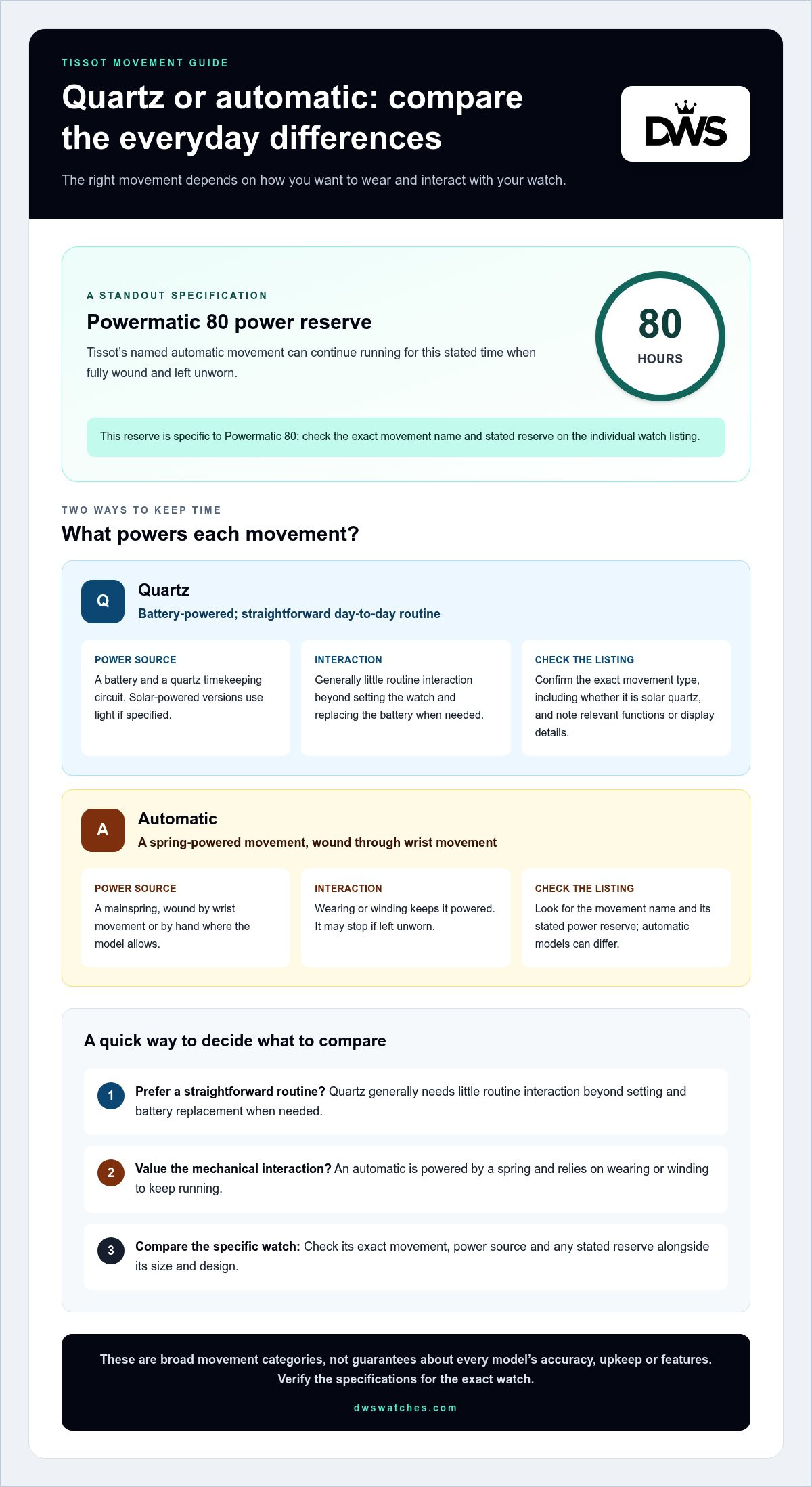
Movement describes how a watch keeps time and what powers it. It also affects how you interact with the watch day to day. A quartz watch uses a battery and a quartz timekeeping circuit, whilst an automatic watch uses a wound spring powered by the movement of the wearer’s wrist. Neither is inherently the better choice. The right fit depends on the routine and feel you want, not on status.
Use this comparison to read product listings with more confidence:
| Detail | Quartz | Automatic |
|---|---|---|
| Power source | Battery; solar-powered versions use light if specified | A mainspring, wound by wrist movement or by hand where the model allows |
| User interaction | Generally little routine interaction beyond setting the watch and battery replacement when needed | Wearing or winding keeps the movement powered; it may stop if left unworn |
| Points to check | Exact movement type, including whether it is solar quartz | Movement name and stated power reserve |
These are broad movement categories, not guarantees about every watch’s accuracy, upkeep or features. Check the specification for the exact model you’re considering.
What to know about quartz Tissot watches
Quartz movements use an electrical current to make a quartz crystal vibrate at a steady rate, helping regulate timekeeping. For a practical comparison, look beyond the word “quartz” in the listing. Check whether the model is described as solar quartz, and note any stated functions or display details that matter to you. Tissot watches can have different specifications, so verify the precise movement for each model rather than assuming all quartz versions are alike.
What to know about automatic Tissot watches
An automatic movement stores energy in a spring. A rotor inside the watch turns with wrist movement and winds that spring. Powermatic 80 is a named Tissot automatic movement. Its stated 80-hour power reserve describes how long it can continue running when fully wound and left unworn. Treat this as a model-specific detail: confirm the movement name and reserve on the individual listing, as automatic watches can differ.
In everyday terms, quartz may suit someone who prefers a straightforward routine, whilst an automatic can appeal to someone who values a mechanical movement and its interaction with wear. Consider how often you’ll wear the watch and whether you’re comfortable with it stopping after time off the wrist. These practical preferences are more useful than treating one movement as a mark of superiority.
Before shortlisting, compare the exact movement, power source and any stated reserve alongside the watch’s size and design. If you’re weighing up other brands and styles too, browse the wider designer watch selection and apply the same specification checks.
Tissot collections compared: find the style that matches your preference
Tissot groups its catalogue across classic, sport and design-inspired styles. Collection names help narrow a search by visual direction, but the exact model still determines its details. Start with the style you’re drawn to, then compare individual listings instead of assuming every watch in a collection has identical features.
The table offers a starting point for comparing four familiar collections. The style descriptions are broad observations, not claims about a model’s performance or suitability for a particular activity.
| Collection | Broad style impression | Details to verify on individual listings |
|---|---|---|
| PRX | Contemporary sport styling with an integrated-bracelet design | Case size, dial layout, bracelet and movement |
| Seastar | Sport-focused, with a professional-diver design direction | Exact water-resistance rating, case dimensions, strap or bracelet and movement |
| Gentleman | A versatile, modern look that can read as smart or casual | Case size, dial and colour, bracelet or strap, and movement |
| Le Locle | A classic, dress-oriented appearance | Dial details, case size, materials and movement |
How to read familiar Tissot collection names
PRX signals an integrated-bracelet design, whilst Seastar points towards a sport-led look. Gentleman and Le Locle offer different visual cues: one is more contemporary and adaptable in appearance, the other more traditional. These are useful collection-level distinctions, not promises about a specific model. Tissot watches within the same family can vary, so compare the listing’s photographs and specification details before deciding.
Classic, sport and design-led styles: what differs?
Classic designs often use restrained dial layouts and details associated with dress watches. Sport styles tend towards a more assertive case and dial presence, whilst design-led options can place greater emphasis on the overall shape or bracelet. These are visual categories, not activity ratings. A sport label alone doesn’t establish whether a watch is suitable for swimming or another use.
Small changes can shift a watch’s character. A larger case may look more prominent on the wrist; a clean dial can feel formal, whilst extra markings or contrasting colours can make the face appear busier. A metal bracelet and a strap also create different impressions and may feel different in daily wear. Use product images to assess the look, then rely on written specifications for dimensions, materials and any functional rating.
Compare similar versions side by side. Note the reference or model name, then check whether the case size, dial colour, movement and strap or bracelet match your preferences. This makes it easier to distinguish a style you like from the exact version that suits your shortlist. If you’re comparing other brands as well, browse the wider designer watch selection using the same visual and specification checks.
How to choose a Tissot watch: a practical shortlist in four steps
A clear shortlist starts with your routine, not a feature count. Use these four steps to move from a general preference to a specific model. They work whether you’re choosing for yourself or comparing tissot watches as a gift.
- Define the intended use. Decide where you expect to wear the watch and how often. A watch for regular office wear may call for a different look from one chosen mainly for weekends or formal occasions. If you have a particular activity in mind, use the exact model’s stated specifications to assess suitability.
- Choose a style direction. Consider whether you prefer a classic, sport-focused or design-led appearance. Compare the dial layout, case finish, colour and strap or bracelet. These visible details shape how a watch looks with your usual clothing and help narrow the range before you compare technical specifications.
- Select a movement. Decide whether quartz or automatic better fits your preferences and routine. Check the specific listing rather than relying on a collection name, as models within a range can have different movements. If reserve or power source matters to you, note the exact wording given for that model.
- Review the exact model specifications. Compare case diameter and thickness where provided, then check materials, strap or bracelet details and water-resistance wording. Use the stated rating only as written; don’t assume it makes a watch suitable for a particular activity. Keep the model or reference details with your shortlist so you can compare like with like.
Match the watch to your wardrobe and routine
Think about the settings where you’ll wear it most and whether it will be an occasional choice or part of your everyday rotation. A restrained dial and simple colour scheme may sit easily with formal clothes, whilst a more pronounced case or contrasting dial may create a stronger visual statement. Treat these as style preferences. For activity suitability, rely on the individual model’s stated specifications.
Check fit and model specifications before deciding
Case diameter gives a useful indication of the watch’s width, whilst thickness helps you judge how much it may stand above the wrist. Neither measurement determines comfort on its own. Wrist shape, strap adjustment and personal preference all matter. Compare the figures across your shortlist, then review each model’s movement, materials, strap details and water-resistance rating. Don’t assume specifications carry across a collection.
Once you’ve set your criteria, browse the wider designer watch selection and apply the same checks to each listing.
From Tissot research to your next watch shortlist
Research is most useful when it leaves you with a clear shortlist, not just a collection name. Compare the style you prefer, the movement that fits your routine, the watch’s size and its overall design. Then check the exact model listing. Two watches within the same collection can differ in movement, dimensions, materials and other specifications, so compare like with like.
A final checklist before choosing any watch
Before settling on a model, work through these checks. They help turn a broad search for tissot watches into a decision based on the particular watch, rather than assumptions about the brand or collection.
- Confirm the exact model name and read its own product specifications.
- Compare case size with the wearer’s comfort preferences, and consider whether the strap or bracelet and dial design suit their wardrobe.
- Check the movement and materials listed for that version, rather than relying on details from another model in the range.
- Read the stated water-resistance rating as a model-specific specification. Don’t treat it as an activity recommendation.
For a gift, the intended wearer’s usual style and comfort preferences can help guide the choice. For a personal purchase, consider how often you expect to wear the watch and whether its design will work across the settings you have in mind. These points are more useful than treating a higher price as proof that one model is better for you.
Browse beyond one brand without losing your criteria
Comparing other brands can give useful context, provided you keep the same criteria. The best value designer watch brands guide offers a broader brand perspective. If you want to widen the search by budget, use the affordable designer watches UK guide alongside your preferred style and specification checks.
When considering retailer value, compare the full listing and the information provided about the individual watch. The designer watches for sale UK guide adds wider shopping context. Keep your shortlist consistent: compare movement with movement, case measurements with case measurements, and listed materials with listed materials.
Finish with the model whose design, fit and stated details best match your needs. If you’re still exploring, browse the wider watch selection and apply the same checks across the options. A focused shortlist makes the final comparison clearer, without relying on a collection name alone.
Take your next step with a clearer shortlist
Let your preferences guide the next search. The aim isn’t to choose a watch because a name is familiar, but to find one whose design and stated details make sense for the way you plan to wear it. Your research into tissot watches can also help you recognise which features matter when comparing the wider designer watch market.
Keep your shortlist practical. Note the style you prefer, the movement you’re considering and the case measurements that feel comfortable. Then use those criteria to compare individual watches across brands, without assuming that similar designs share the same specifications.
For a broader selection, browse the watch selection. Designer Watch Store UK lists 100 % Authentic watches, with Free UK Delivery, a Best Price Promise and Easy Returns. Explore the available options using your criteria, and choose a shortlist that feels considered and personal.
Frequently Asked Questions
Is Tissot a Swiss watch brand?
Yes. Tissot is a Swiss watch brand, founded in Le Locle, Switzerland. The brand’s Swiss identity is useful background, but it doesn’t mean every model has the same components, materials or specifications. For those details, refer to the individual watch listing.
When was Tissot founded?
Tissot was founded in 1853 in Le Locle, Switzerland. The date provides historical context, but it doesn’t establish what a particular watch is made from or how it works. For those details, use the specific model’s specifications rather than drawing conclusions from the brand’s history.
Are Tissot watches considered luxury watches?
“Luxury” can refer to different expectations around price, design and brand positioning, so it isn’t a precise specification. Rather than relying on the label, compare the individual watch’s movement, materials, design and stated details with what matters to you. Someone choosing a gift may focus on appearance and fit, whilst a regular wearer may pay closer attention to the model’s functions and construction. The listing gives a more useful basis for comparison.
What is the Tissot PRX collection?
PRX is a Tissot collection associated with an integrated-bracelet design. Treat the name as a way to find related models, not as a complete specification. Compare the exact watch’s design, movement and size before deciding; don’t assume that one version’s features apply to every PRX model.
Does every Tissot watch use the same movement?
No. Tissot models can use different movement types, including quartz and automatic movements. A collection name alone doesn’t identify which movement a particular watch uses. If you’re comparing tissot watches, read the exact product listing and note the movement stated there. This avoids basing your choice on specifications from another model.
Can every Tissot watch be worn for swimming?
Don’t assume every Tissot watch is suitable for swimming. Water resistance is specific to the individual model, and a rating alone doesn’t establish suitability for a particular activity. Read the exact watch’s stated rating and follow the manufacturer’s guidance on intended use. A rating shown for one watch shouldn’t be applied to another, even if both share a collection name or look similar.
Does Tissot offer a warranty on its watches?
Warranty terms and coverage are separate from a watch’s movement or design specifications. Review the current warranty information that applies to the particular watch and purchase, including any conditions on what the coverage includes. Don’t assume that terms for one model or purchase apply to another.