


The most expensive watch isn’t automatically the right one. A list of top male watches can help you discover options, but the best choice depends on how you’ll wear it, what you need it to do and which designs feel like you.
With so many styles, brands and specifications to compare, it’s easy to focus on popularity or price instead of everyday fit. Start with the details that affect how you use a watch: style, movement, comfort, legibility and useful functions. A clear shortlist makes those choices easier to compare.
This guide explains the main watch styles and the difference between quartz and mechanical movements, then sets out practical details to consider before choosing. Use the same framework for each option, from case size and strap to water resistance and features. The aim is to help you find a designer watch that suits your routine and personal style while keeping value in view.
Top male watches: what makes a watch worth shortlisting?
A useful shortlist is personal, not a universal ranking. The top male watches for one wearer may be unsuitable for another: a formal design might not suit an active routine, while a feature-rich watch may add little for someone who wants a simple display. Start with the watch you’ll reach for regularly, not the one with the highest profile or price.
Compare each option against the same five criteria: comfort, legibility, style, intended use and value. A good shortlist puts comfort, a clear display, personal style, everyday purpose and fair value ahead of popularity. Use those criteria as a quick test while browsing. If a watch misses a requirement you consider essential, remove it rather than trying to justify the choice.
Value is not simply the lowest price. Consider whether the design and functions suit your routine, and how often you expect to wear it. A watch that works with your usual clothes and daily plans may offer more practical value than one chosen for status alone.
Which watch qualities matter in daily wear?
Look for a display you can read at a glance. Clear markers, hands that stand out against the dial and an uncluttered layout can make checking the time easier throughout the day. Comfort matters just as much: consider how the case sits on your wrist, whether its proportions feel balanced and whether the strap suits hours of wear.
Separate useful functions from attractive extras. If you regularly need a date display, it may earn a place on your list. If you rarely use extra timing features, they may not deserve priority. Match the design to your routine, too. A restrained watch may suit smart workwear, while a bolder dial or casual strap may feel more natural at weekends. The List of watch manufacturers offers a broad view of brands in the market, but the right choice still depends on your preferences.
How to read a shortlist without following a ranking blindly
Rankings can introduce styles and brands you might not have considered. Treat them as inspiration, not proof that every featured watch will work for you. A market ranking may reflect popularity or other measures, but it can’t tell you whether a particular case feels comfortable or suits your wardrobe.
Make two columns as you compare options. Record objective details, such as movement type, display layout and materials, separately from preferences such as dial colour and overall design. Then assess each option against your essentials. If it fails a non-negotiable requirement, cross it off. This simple filter turns a long catalogue into a manageable selection and keeps your decision grounded in how you’ll actually wear the watch.
Men’s watch styles and movements: understand the differences
Style and movement are two separate ways to compare a watch. Style describes its appearance and design cues; movement is the mechanism that keeps time. A watch can have a formal look with a quartz movement, or a sportier design with an automatic one. Choose the style for how you want the watch to look, and the movement for how you want it to run.
Keeping those choices separate makes the top male watches easier to assess. First decide which designs suit your clothes and routine. Then compare movement types by their practical differences and your own preferences.
Dress, field, dive-style and chronograph watches
Each style has a distinct visual character. Think about where you’ll wear it and whether the design feels at home with your usual clothes.
- Dress watches tend to have a clean, pared-back appearance, with a simple dial and details suited to formal or smart outfits.
- Field watches often look practical and robust, with clear markings designed for easy reading. Their straightforward appearance can work with casual everyday clothing.
- Dive-style watches commonly have a bolder, sportier look, with a prominent bezel and a strong visual presence. Consider whether that suits your wardrobe, even if you don’t need a watch for water-based activities.
- Chronographs include a timing function, usually shown through extra sub-dials and controls. That can be useful for timing events, but creates a busier dial than simpler designs.
These categories are guides, not strict rules. A field-inspired design can still suit smart-casual clothes, while a chronograph may appeal even if you mainly value its appearance. Compare the dial, case and strap together, since each affects how formal or relaxed the watch feels.
Quartz or automatic: what is the practical difference?
A quartz watch uses a battery-powered movement to keep time. An automatic watch uses a mechanical movement powered by the wearer’s motion. Neither is automatically the better choice. The distinction is about how the watch operates and what you prefer in daily use.
Choose quartz if you prefer a battery-powered mechanism. Choose automatic if you’re drawn to a mechanical movement that runs through motion. Consider how you’ll wear the watch, too: an automatic relies on movement to power it, while a quartz watch relies on its battery. Don’t treat one type as a mark of quality on its own.
As you explore designer watches, use style and movement as separate filters. This helps narrow the options without assuming that a particular look or mechanism will suit every wearer.
Compare men’s watches by fit, features and everyday use
A watch can look right in a product image and feel wrong on your wrist. Compare its stated dimensions, display and strap with how you dress and spend your day. This makes it easier to judge top male watches by practical fit, not appearance alone.
Match watch size and strap to comfort
Case diameter is only one part of fit. A thicker case can feel more prominent, while lug-to-lug length, the distance from one end of the case to the other, affects how far it spans your wrist. If the lugs extend beyond the wrist’s edges, the watch may look or feel too large, regardless of its size label. “Oversized” is a style description, not a measure of comfort.
Compare the listed diameter, thickness and lug-to-lug measurement with a watch you already find comfortable. Then consider the strap. A metal bracelet can create a more structured look and suit regular wear with varied outfits. A leather-style strap often reads as smarter and can work well with office or evening clothing. Consider how each feels against your skin and how it fits your usual wardrobe.
Prioritise functions you will actually use
Start with your routine. A date display can be useful if you check it often, but adds little if you rely on another device. A chronograph can help with timing, though its extra controls and dial details may make the face busier. Assess water resistance from the watch’s stated specification, not its sporty appearance. Match the stated rating to your intended use rather than assuming every watch can handle water exposure.
| Detail | Practical benefit and look | Trade-off | May suit |
|---|---|---|---|
| Case proportions | A balanced fit can feel comfortable and sit neatly beneath a sleeve. | A large or thick case may feel prominent during long wear. | Anyone wearing a watch throughout the day. |
| Clear dial | Distinct markers make the time easier to read at a glance. | Extra detail can make the display feel crowded. | Wearers who value quick legibility. |
| Metal bracelet | Creates a structured finish suited to varied outfits. | May feel less relaxed than a strap for some wearers. | Those seeking an adaptable everyday look. |
| Date or timing function | Adds a practical tool for checking the date or timing an activity. | Extra functions can add dial detail you may rarely use. | Wearers with a regular need for that function. |
| Water resistance | Helps you compare a watch’s stated suitability with your routine. | Appearance alone doesn’t establish water resistance. | Anyone planning exposure to water. |
Use the table to remove options that fail a practical requirement, then compare what remains by design and value. For more guidance on balancing style and spend, read this men’s affordable designer watches guide.
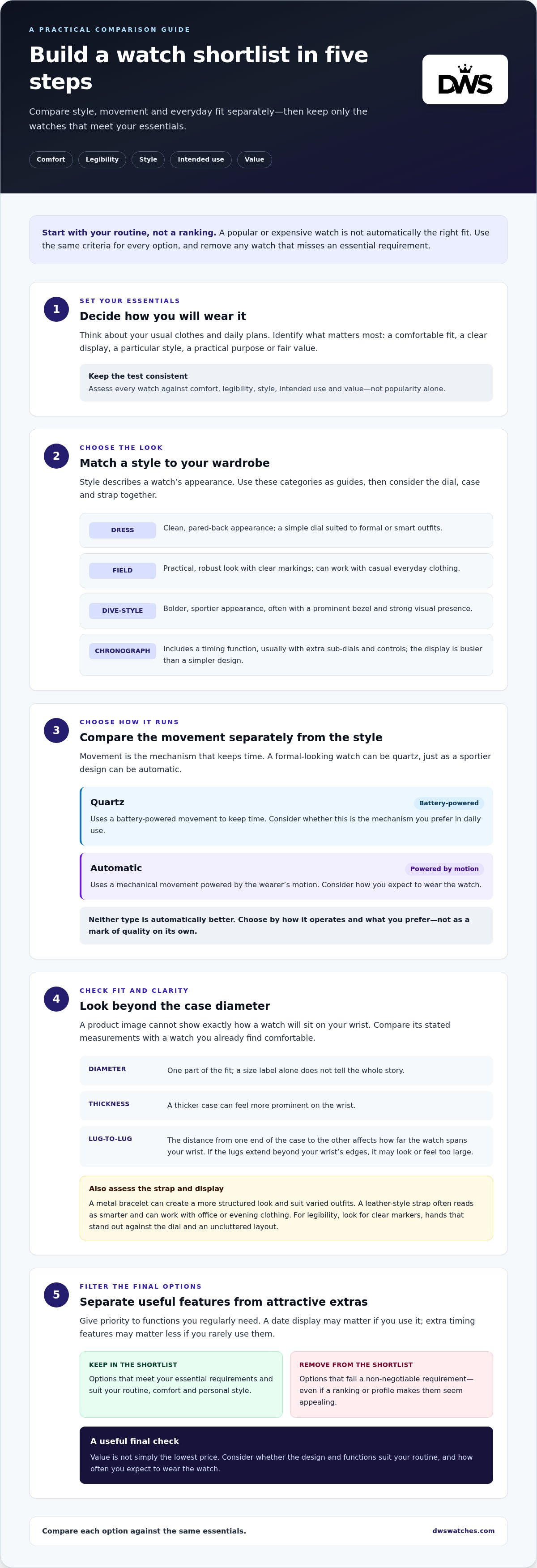
Build a shortlist of top male watches for different occasions
Build your shortlist around the settings where you’ll wear a watch most often. A workday spent in meetings calls for different styling from a weekend outdoors or an evening in formal dress. You don’t need a separate watch for every occasion. Identify the design that fits your routine, then check that it meets your essential requirements before comparing value.
Choose a watch for work, weekends or formal occasions
For work, a restrained design with a legible dial can feel appropriate without drawing attention. Casual wear allows more freedom with colour, a sportier case or a relaxed strap. Formal clothing often pairs best with a cleaner profile that sits neatly beneath a shirt cuff. If your week moves between these settings, a versatile design may be more useful than several specialist styles.
Consider how often each occasion comes around. A watch chosen mainly for rare formal events may see little wear, while an adaptable design could work across the office and weekend plans. For brand comparisons that keep value in view, explore this guide to best value designer watch brands.
Use a four-step shortlist before you buy
Move from broad preferences to a considered choice. Follow these steps in order and keep your requirements consistent as you compare.
- Define your occasions and visual style. Note where you expect to wear the watch most: at work, casually, for formal events or across several settings. Choose a direction, such as understated, sporty or more expressive.
- Set essential requirements. Decide what matters for fit, movement and function. These might include comfortable proportions, a preferred quartz or automatic movement, a clear display or a useful feature.
- Compare only suitable options. Filter out watches that don’t meet those essentials. Then compare the remaining designs by dial, case, strap and how well each suits your clothing and routine.
- Review value and personal fit. Consider the overall design, useful features and likely frequency of wear together. Choose the watch that best balances those factors, rather than defaulting to the most recognisable name.
Keep the shortlist focused. If two options meet your practical needs, compare them in the context of a typical week: which would you reach for on an ordinary workday, and which would still feel right at the weekend? That test can reveal whether a versatile everyday watch suits you better than a more specialised choice.
Once your criteria are clear, explore designer watches with your occasions, style and value priorities in mind.
Explore designer watches for men at Designer Watch Store UK
You now have a framework for deciding which top male watches deserve a closer look. Apply it to options that match your priorities instead of choosing by brand name alone. Designer Watch Store UK is an online retailer serving customers across the UK, with a selection of designer watches from fashion brands and a focus on value for budget-conscious shoppers.
Use your shortlist to guide your browsing. Start with the styles you’re drawn to, then compare available designs against your routine and requirements. A designer watch should feel right in context: consider whether you’ll wear it with work clothes, casual outfits or more formal clothing, and whether its design and functions justify its place in your budget. For another perspective on choosing within the UK market, read this designer watches for sale UK guide.
Shop with your shortlist, not just a brand name
Before comparing options, return to the criteria you’ve set. Keep your preferred style, comfortable fit, movement and useful functions in view. These act as filters, helping you focus on relevant designer watches rather than getting distracted by a familiar name or a striking detail that doesn’t suit your needs.
Compare like with like. Look at the display, case proportions and strap, then consider how each design works with your usual wardrobe. A watch that suits both work and weekends may be more useful than one with a narrower purpose. Value comes from the balance of design, use and personal preference, not from a label alone.
Take the next step towards your men’s watch
Before choosing, check that your preferred option meets these points:
- Occasion: It suits where you expect to wear it most.
- Style: Its dial, case and strap work with your clothing.
- Fit: Its proportions feel comfortable for regular wear.
- Movement and function: They match your preferences and routine.
- Value: The overall design and practical use feel right for your budget.
If an option meets your essentials and still appeals after that comparison, it belongs on your final shortlist. If it misses a priority, set it aside. This keeps the choice focused and personal.
Browse the designer watches online at Designer Watch Store UK and compare options against your shortlist. Take your time, use the criteria that matter to you, and choose a design that fits your everyday life.
Choose a watch you’ll keep reaching for
The right choice isn’t simply the one that looks impressive at first glance. It’s the watch that feels appropriate for your routine, wardrobe and preferences. Give your shortlist a final review, then consider which option you can picture wearing often, not just on a particular occasion.
There’s no need to base your decision on a trend or someone else’s ranking. A considered choice can be quiet and personal. If one design meets your needs and still feels like your style, that’s a stronger reason to choose it than popularity alone.
When you’re ready, explore designer watches at Designer Watch Store UK and compare the options with your shortlist in mind. Keep your priorities clear and choose a watch that feels right for the days ahead.
Frequently Asked Questions
Is a men’s watch a good gift?
Yes, a men’s watch can be a considered gift if it reflects the recipient’s taste and routine. Look at the accessories they already wear: a simple metal bracelet may suit someone who favours classic details, while a colourful dial could appeal to someone with a more expressive style. If you’re unsure, choose from top male watches with versatile designs to reduce the risk of selecting something too specialised.
Can you wear a dive-style watch with a suit?
Yes, a dive-style watch can work with a suit if the overall combination feels balanced. Consider the suit’s formality and the watch’s visual weight. A dark, uncluttered dial and a muted bezel can sit more comfortably with business clothing than bright colours or prominent detailing. Matching the metal finish to other accessories, such as a belt buckle or cufflinks, can also make the pairing feel more considered.
What happens if a watch is too large for your wrist?
A watch that’s too large can move out of position, catch on a shirt cuff or feel awkward during everyday tasks such as typing. Check how it sits while your arm is relaxed, not only when viewed from above. If the case rotates easily or the crown presses into your hand as your wrist bends, the fit may not be practical for regular wear.
Is an analogue or digital watch better for everyday wear?
Neither format is better for everyone. Choose an analogue display if you prefer traditional hands and a dial that pairs easily with varied clothing. A digital display may suit you if you like reading the time in numerals or want information presented directly. Consider where you’ll check it most, such as outdoors or in a dim room, and whether the display remains easy for you to read there.
Can you change a watch strap to alter its style?
Yes, changing a compatible strap can give a watch a different feel, from relaxed to more formal. Before choosing one, check the attachment type and the width where the strap meets the case. Also consider the buckle or clasp, since its finish affects the overall look. A strap that fits the attachment but feels uncomfortable or doesn’t suit the watch’s proportions may not be a useful change.
How many watches should a man own?
There’s no ideal number. One watch may be enough if it suits the clothes and occasions you wear most often. If you regularly move between settings with different dress expectations, a second option could fill a clear gap. Before adding another, consider whether it offers a genuinely different use or simply duplicates a style you already reach for. Choose based on your routine, not a target number.